New Rules Could Unearth Growth For
Allotments
Proposed changes to overhaul allotment
rules is likely to have a positive
economic impact locally, according to
Tayside Biodiversity Partnership.
Rural
Affairs Secretary Richard Lochhead recently launched a
consultation to consider the shape of future allotment
legislation as part of the proposed Community Empowerment and
Renewal Bill (CERB).
The
consultation will consider what changes should be made to the
existing legislation to make it simpler for people to gain
access to a plot and grow their own food.
A
spokesman for Tayside Biodiversity Partnership said: “There is
potential for greater local food and slow food-style projects —
with a positive consequent economic impact on the local
community, not just in selling or swapping produce, but also
giving an opportunity for local entrepreneurs to use local
produce in making and selling jams, chutneys, honey, ready-meals
and desserts, tisanes, soups, fruit juices, cider, perry,
skin-care products, etc."
“There is
also likely to be a positive health impact on the local
community, not just in greater numbers of all ages undertaking
allotment plots, but also in the provision of good quality,
locally-grown food, herbs and fruit."
“Hand in
hand with the increased demand for allotments and community
growing comes the need to demonstrate how to cook
locally-produced food and to engender an interest in school
children, young families and the elderly, not just in producing
the food, but also cooking it for themselves, using surplus
produce in local care homes, schools, local businesses, and
potentially selling produce to local catering businesses to
contribute towards the local economy.”
The
Tayside organisation also gave its views to MSPs on placing a
duty on councils to provide a specific number of allotments in
their area per head of population.
The
spokesman added: “This may be fair to ensure that as many people
who want to have an allotment can do so."
“Perhaps
the wider community use of established green-space should be
considered at the same time so that not just allotments are made
available to local people, but also community gardens and
community orchards are considered too."
“This
would widen the opportunities for local people who may not want
an allotment, but are willing to work with others in producing
and sharing local, good quality, produce."
“For
instance, building-top community beehives, vegetables on
roundabouts and road verges (like at Stirling), community input
into greenspace management around hospitals, care homes, schools
and colleges.”
Tayside
Biodiversity Partnership has responded to the consultation along
with 84 others which will help inform the development of a draft
Bill.
An
analysis report on the content of the responses will be
published later this year.
Allotments open for business
The wait for
a plot is getting shorter
 For
many town & city-dwellers, allotments have become a frustrating
mirage: great in theory, impossible to get hold of in practice.
The past few years have seen plenty of stories about long
waiting lists, council closures and plots sold off for
development, and rather fewer causes for optimism. For
many town & city-dwellers, allotments have become a frustrating
mirage: great in theory, impossible to get hold of in practice.
The past few years have seen plenty of stories about long
waiting lists, council closures and plots sold off for
development, and rather fewer causes for optimism.
With
events around the country, all is not gloomy in the allotment
world though. According to a new study by the National Allotment
Society and Transition Town West Kirby, published in July,
waiting list figures have fallen 15 per cent in the past two
years.
The
report surveyed 152,432 plots, at all 323 principal authorities.
It found that there are now 78,827 would-be plotters waiting for
an allotment: that's 52 people per 100 plots. In 2011, when the
last survey took place, there were 57 per 100 plots. So why have
numbers fallen?
There are
certainly some myths knocking around the grow-your-own
"community". One fantasy is that councils are selling off loads
of plots to make ends meet. All the allotment groups spoken to
said that this has more-or-less stopped, because there is so
much pressure on councils to keep plots as growing spaces these
days (good news). What's more, their allotments are now
productive and not the neglected spaces they were a decade ago
(with some glaring exceptions it has to be said, but usually due
to bad management within the allotment groups). In fact, many
councils are expanding their holding of allotments: over the
past two years, 51 councils have created a total of 2,000 new
plots, or 30 hectares of growing space across 65 new sites.
Another
myth is that recent immigrants are causing longer waiting lists.
There is little evidence of this. In Boston, Lincolnshire, for
example, where nearly five per cent of the population is Polish,
waiting lists have fallen (though prices per plot per year are
going up - bad news).
Weeds, Weeding &
Weed-killers
Lets face it, weeds are a real
source of headaches, annoyance
and general nuisance for most gardeners, some
of us even
develop a hate complex for them!
They choke our crops, leach
minerals from our soil, they often
harbour pests that attack our
crops, and
they impoverish our cultivated plants
by competing with them for food
& water - to mention but a
few problems they cause. A weed strewn allotment
plot is NEVER a productive one
and is a weed seed factory
that affects neighbouring plots.
That's before we start pointing
out how they spoil the overall
effectiveness of our work and
make the area we work on look
like a real neglected eye-sore.
On the positive side, there ARE
good weeds, a huge number have
beneficial health and medicinal
properties, some can be
nutritious for us to eat
(although they don't all taste
that nice) and they've formed
the foundation for herbalists to
cure us of our ailments for
centuries. They also help in
keeping bio diverse balance
which benefits certain insects. However this is not a
valid argument for allowing them
to grow where they can be a real
problem. There IS a place for
them, but not in the areas we've
set aside for other varied crops that
we need to grow and eat to
sustain ourselves on a community
scale.
So what's the best solution?
Well you can:
-
work hard to eliminate
their presence by digging them up on your 'patch',
-
work equally hard to
keep the annual varieties that germinate every year under
control by hand weeding,
-
hoe regularly,
-
make efficient use of
mulches or
-
you can take a lazy
short-cut and make them disappear - as if by magic - through
the application of poisons to their leaves and/ or poison the soil
they grow in
 There is a weed-killer that has
been developed by Monsanto
that's marketed as 'harmless'.
The company have done a terrific
job convincing governments,
horticultural food growers,
farmers and the public
generally, that their product
causes no harm whatsoever,
except to the actual plant it
comes in contact with of course
- but nothing else. Furthermore
they say it's rendered neutral and safe
when it comes in contact with
the soil. So what's wrong with
using a little of this innocent
and benign concoction? After
all, isn't it the answer to all
our prayers, where we no longer
need to use potent and deadly
poisons to kill our weeds?
Without it wouldn't we still have
to depend on the old fashioned
really harmful stuff (like
sodium chlorate - remember that
stuff?). So we're
all lulled into a sense of
security, confident in the
knowledge that what Monsanto
says is true. So no one even
bats an eye-lid when you reach
for that innocent little bottle of Roundup.
Full marks to Monsanto on their
excellent marketing con - or to
put it bluntly the way they've
hidden the truth and tarted up
the reality with lies! There is a weed-killer that has
been developed by Monsanto
that's marketed as 'harmless'.
The company have done a terrific
job convincing governments,
horticultural food growers,
farmers and the public
generally, that their product
causes no harm whatsoever,
except to the actual plant it
comes in contact with of course
- but nothing else. Furthermore
they say it's rendered neutral and safe
when it comes in contact with
the soil. So what's wrong with
using a little of this innocent
and benign concoction? After
all, isn't it the answer to all
our prayers, where we no longer
need to use potent and deadly
poisons to kill our weeds?
Without it wouldn't we still have
to depend on the old fashioned
really harmful stuff (like
sodium chlorate - remember that
stuff?). So we're
all lulled into a sense of
security, confident in the
knowledge that what Monsanto
says is true. So no one even
bats an eye-lid when you reach
for that innocent little bottle of Roundup.
Full marks to Monsanto on their
excellent marketing con - or to
put it bluntly the way they've
hidden the truth and tarted up
the reality with lies!
It’s been WAY too long since I
went on a good ol' fashioned garden chemical
tirade! I always assume that
people realize the extreme
dangers posed by herbicides (of
ALL kinds) and
other garden poisons. But I tend
to forget how bombarded they are
with ads and misleading facts,
imploring them to use the junk,
often implying that the toxins
are somehow harmless. Like when
Monsanto says that their Roundup
is as harmless as table salt-which
is actually very true - in a funny
sort of way
-
since salt is one of the most
corrosive substances on the
planet!
And yes, evidence strongly
suggests that Roundup’s
so-called ‘inert ingredients’ (a
decision often made solely by
the manufacturer) are even worse
than the ‘active’ ingredient,
the extremely nasty chemical
glyphosate. That’s why, when
Monsanto talks about their
popular concoctions of weed
killers, they always say “the
active ingredient in Roundup
does this or that”. They never
talk about the actual product,
which kills earthworms and
beneficial insects, has been
linked to non-Hodgkin’s
lymphoma, and is taken up
internally by any plants it
doesn’t kill-so if you foolishly
use it to control weeds in your
veggie garden, you’ll be eating
Round-Up for the next two years.
Yummy yummy - ENJOY won't you?!
GLYPHOSATE (brand name
Roundup) IS IT SAFE?
“Historians may look back
and write about how willing we
are to sacrifice our children
and jeopardize future
generations with a massive
experiment that is based on
false promises and flawed
science just to benefit the
bottom line of a commercial
enterprise.” So said Don Huber
in referring to the use of
glyphosate and genetically
modified crops. Huber was
speaking at Organic Connections
conference in Regina, Canada, in
late 2012.
Huber is an emeritus
professor in plant pathology at Purdue University in the US and
has worked with the Department of Homeland Security to reduce
the impact of plant disease outbreaks. His words are well worth
bearing in mind given that a new study commissioned by Friends
of the Earth Europe (FoE) and GM Freeze has found that people in
18 countries across Europe have been found to have traces of
glyphosate in their urine (1).
Friends of the Earth Europe
commissioned laboratory tests on urine samples from volunteers
in 18 countries across Europe and found that on average 44
percent of samples contained glyphosate. The proportion of
positive samples varied between countries, with Malta, Germany,
the UK and Poland having the most positive tests, and lower
levels detected in Macedonia and Switzerland. All the volunteers
who provided samples live in cities, and none had handled or
used glyphosate products in the run-up to the tests.
The Influence of the
Biotech Sector on Safety and Regulation
Although ‘weedkiller in
urine’ sounds alarming, Tom Sanders, head of the nutritional
sciences research division at King’s College London, says the
levels found are unlikely to be of any significance to health
because they are 300 times lower than the level which might
cause concern. Alison Haughton, head of the Pollination Ecology
Group at Rothamsted Research, said that if FoE and GM Freeze
want their work to have scientific credibility and provide a
genuine contribution to the debate on pesticide residues, they
should submit their work for publication in a peer-reviewed
journal.
Valid
points, you might think. But FoE believes that there is
sufficient evidence to suggest environmental and health impacts
from glyphosate warrant concern. It wants to know how the
glyphosate found in human urine samples has entered the body,
what the impacts of persistent exposure to low levels of
glyphosate might be and what happens to the glyphosate that
remains in the body. New research published in the journal
Entropy sheds disturbing light on such concerns (discussed later
in this article).
In
2011, Earth Open Source said that official approval of
glyphosate had been rash, problematic and deeply flawed. A
comprehensive review of existing data released in June 2011 by
Earth Open Source suggested that industry regulators
in Europe had known for years that glyphosate causes birth
defects in the embryos of laboratory animals. Questions were
raised about the role of the powerful agro-industry in rigging
data pertaining to product safety and its undue influence on
regulatory bodies .

Read Prof. Gilles-Eric Séralini's REPORT
|
In the
same vein, FoE says there is currently very little testing for
glyphosate by public authorities, despite its widespread use,
and authorities in Europe do not test for glyphosate in humans
and tests on food are infrequent. Glyphosate was approved for
EU-wide use in 2002, but FoE argues that the European regulatory
agencies did not carry out their own safety testing, relying
instead on data provided by the manufacturers.
Of course
there are certain scientists (usually with links to the
agro-industry) who always seem to be strident in calling for
peer-reviewed evidence when people are critical of the biotech
sector, but then rubbish it and smear or intimidate the
scientists involved when that occurs, as has been the case with
Dr Arsad Pusztai in the UK or Professor Seralini in France. It
is therefore quite revealing that most of the data pertaining to
glyphosate safety came from industry studies, not from
peer-reviewed science, and the original data are not available
for independent scrutiny.
|
Increasing Use
With
references to a raft of peer-reviewed studies, FoE also brings
attention to the often disturbing health and environmental
dangers and impacts of glyphosate-based herbicides throughout
the world . The FoE study also highlights concerns around the
increasing levels of exposure to glyphosate-based weed killers,
particularly as the use of glyphosate is predicted to rise
further if more genetically modified (GM) crops are grown. It is
after all good for business. And the biggest producer of
glyphosate is Monsanto, which sells it under the brand name
‘Roundup’.
“The figures don’t lie; GMOs
drive glyphosate sales.”
Despite its widespread use,
there is currently little monitoring of glyphosate in food,
water or the wider environment. The FoE commissioned study is
the first time monitoring has been carried out across Europe for
the presence of the weed killer in human bodies. FoE Europe’s
spokesperson Adrian Bebb argues that there
is a serious lack of action by public authorities and indicates
that this weed killer is being widely overused.
 This
certainly needs to be addressed not least because the prediction
concerning increasing exposure to glyphosate is not without
substance. The introduction of Roundup Ready crops has
already resulted in an increase of glyphosate use. Using
official US government data, Dr Charles Benbrook, research
professor at the Centre for Sustaining Agriculture and Natural
Resources at Washington State University, states that since 1996
the glysophate rate of application per crop year has tripled on
cotton farms, doubled in the case of soybeans and risen 39
percent on corn. The average annual increase in the pounds of
glyphosate applied to cotton, soybeans, and corn has been 18.2
percent, 9.8 percent, and 4.3 percent, respectively, since
herbicide tolerant crops were introduced.Glyphosate is used on many
genetically modified crops. 14 new GM crops designed to be
cultivated with glyphosate are currently waiting for approval to
be grown in Europe. Approval of these crops would inevitably
lead to a further increase of glyphosate spraying. In the US,
biotech crops, including corn, soybeans, canola and sugar-beets,
are planted on millions of acres annually. This
certainly needs to be addressed not least because the prediction
concerning increasing exposure to glyphosate is not without
substance. The introduction of Roundup Ready crops has
already resulted in an increase of glyphosate use. Using
official US government data, Dr Charles Benbrook, research
professor at the Centre for Sustaining Agriculture and Natural
Resources at Washington State University, states that since 1996
the glysophate rate of application per crop year has tripled on
cotton farms, doubled in the case of soybeans and risen 39
percent on corn. The average annual increase in the pounds of
glyphosate applied to cotton, soybeans, and corn has been 18.2
percent, 9.8 percent, and 4.3 percent, respectively, since
herbicide tolerant crops were introduced.Glyphosate is used on many
genetically modified crops. 14 new GM crops designed to be
cultivated with glyphosate are currently waiting for approval to
be grown in Europe. Approval of these crops would inevitably
lead to a further increase of glyphosate spraying. In the US,
biotech crops, including corn, soybeans, canola and sugar-beets,
are planted on millions of acres annually.
Increasing Dangers
Evidence
suggests that Roundup could be linked to a range of health
problems and diseases, including Parkinson’s, infertility and
cancers, according to a new peer-reviewed report, published
recently in the scientific journal Entropy. The study also
concluded that residues of glyphosate have been found in food.
These
residues enhance the damaging effects of other food-borne
chemical residues and toxins in the environment to disrupt
normal body functions and induce disease, according to the
report, authored by Stephanie Seneff, a research scientist at
the Massachusetts Institute of Technology, and Anthony Samsel, a
science consultant. The study says that negative impact on the
body is insidious and manifests slowly over time as inflammation
and damages cellular systems throughout the body.
In 2010,
the provincial government of Chaco province in Argentina issued
a report on health statistics from the town La Leonesa. The
report showed that from 2000 to 2009, following the expansion of
genetically-modified soy and rice crops in the region (and the
use of glyphosate), the childhood cancer rate tripled in La
Leonesa and the rate of birth defects increased nearly fourfold
over the entire province. Sobering figures.
Professor
Huber also notes the health risks associated with the
(increasing) use of glyphosate. He says a number of plant
pathogens are emerging, which when consumed could impact human
health. Based on research that he alludes to (he refuses to make
his research public or identify his fellow researchers, who he
claims could suffer substantial professional backlash from
academic employers who received research funding from the
biotechnology industry), Huber notes that the use of glyphosate
changes the soil ecology, killing many bacteria, while giving
other bacteria a competitive advantage. This makes plants highly
susceptible to soil borne diseases. At the same time, glyphosate
has a negative effect on a number of beneficial soil organisms.
Huber’s
concerns about the impact of long term use of glyphosate on soil
sterility are similar to concerns expressed by Elaine Ingham, a
soil ecologist with the Rodale Institute, and also research
carried out in by Navdanya in India.
As for GM
crops, Huber says they have lower water use efficiency, tend to
be nutrient deficient, have increased bud and fruit abortion and
are predisposed to infectious diseases and insect damage. He
suggests that Roundup Ready crops, treated with glyphosate, have
higher levels of mycotoxins and lower nutrient levels than
conventional crops.
“…
you could say that what you’re doing with glyphosate is
you’re giving the plant a bad case of AIDS. You’ve shut down
the immune system or the defence system.” Professor Ron
Huber.
He
concludes that, when consumed, the GM crops were more likely to
cause disease, infertility, birth defects, cancer and allergic
reactions than conventional crops.
Huber
claims that consumption of food or feed that was genetically
modified could bring the altered genes in contact with the
microbes in the guts of the livestock or people who eat them. He
feels this increases diseases, such as celiac disease,
allergies, asthma, chronic fatigue syndrome, diabetes, gluten
intolerance, irritable bowel disease, miscarriage, obesity and
sudden infant death syndrome.
While
none of these findings conclusively prove that plant (or animal)
diseases are caused by the glyphosate, Huber feels safety
evaluations have been inadequate, suggesting that previous (GM
sector) research was substandard and extremely misleading in its
interpretation of results – or worse.
With some
hugely powerful players involved here, many of whom have
successfully infiltrated important government and official
bodies, much of the science and the ensuing debate
surrounding glyphosate is being manipulated and hijacked by
vested interests for commercial gain.
Some More Background Information:
During the
early 1970s, Monsanto founded
their Agricultural Chemicals
division with a focus on
herbicides, and one herbicide in
particular: RoundUp
(glyphosate). Because of its
ability to eradicate weeds
literally overnight, Roundup was
quickly adopted by commercial
crop growers. Its use increased
even more when Monsanto
introduced “RoundUp Ready”
(glyphosate-resistant) crops,
enabling growers to saturate the
entire field with weed-killer
without killing the crops.
While
glyphosate has been approved by
regulatory bodies worldwide and
is widely used, concerns about
its effects on humans and the
environment persist. RoundUp has
been found in samples of
groundwater, as well as soil,
and even in streams and air
throughout the Midwest U.S., and
increasingly in food. It has
been linked to butterfly
mortality, and the proliferation
of super-weeds. Studies in rats
have shown consistently negative
health impacts ranging from
tumours, altered organ function,
and infertility, to cancer and
premature death.
Health and Environmental
Impacts of Monsanto's Roundup
Pesticide
A recent study by eminent
oncologists Dr. Leonard Hardell
and Dr. Mikael Eriksson of
Sweden, has revealed clear links
between one of the world’s
biggest selling herbicide,
glyphosate (commonly known as
Roundup, marketed by Monsanto),
to non-Hodgkins lymphoma, a form
of cancer - NHL.
There are even requests for
permits for higher residues on
genetically engineered foods
because they are highly
resistant to herbicides, instead
of reducing herbicide use,
glyphosate resistant crops may
result in increased residues.
They are already on sale.
Commercial crop producers
knowing that their crop will
tolerate or resist being killed
off by the herbicides will tend
to use them more liberally.
There have been no risk/benefit
analysis carried out, so the
regulatory authorities have
failed to implement the
precautionary principle with
respect to GMOs.
(“Herbicide
Tolerance,” New Study Links
Monsanto’s Roundup to cancer,”
www.biotech-info.net/glyphosate_cancer.html
- June 2001)
The Women’s Cancer Resource
Center (WCRC) and CHOSE
(Coalition for a Healthy Oakland
School Environment), showed that
chemicals such as Round-Up
(glyphosate) can result in
reproductive damage as well as
damage to the kidney and liver,
and some studies show a link
between the chemical and cancer.
(Chemical
Injury Network, June 2001)
Glyphosate (Roundup) is one
of the most toxic herbicides,
and is the third most commonly
reported cause of pesticide
related illness among
agricultural workers. Products
containing glyphosate also
contain other compounds, which
can be toxic. Glyphosate is
technically extremely difficult
to measure in environmental
samples, which means that data
is often lacking on residue
levels in food and the
environment, and existent data
may not be reliable.
(“Greenpeace
Report - Not ready for Roundup:
Glyphosate Fact Sheet,”
greenpeace.org - April 1997)
Glyphosate is found in weed
killers and may cause
cardiovascular,
gastrointestinal, nerve, and
respiratory damage.
(“Special
Report: what you need to know
about pest control,” Natural
Health Magazine, May/June 2001)
Roundup: Label - Keep out of
reach of children, harmful if
swallowed, avoid contact with
eyes or prolonged contact with
skin. Remove clothing if
contaminated. Spray solutions of
this product should be mixed,
stored and applied only in
stainless steel, aluminium,
fibreglass, plastic and
plastic-lined steel containers.
This product or spray solutions
of this product react with such
containers and tanks to produce
hydrogen gas that may form a
highly combustible gas mixture.
This gas mixture could flash or
explode, causing serious
personal injury, if ignited by
open flame, spark, welder’s
torch, lighted cigarette or
other ignition source. Avoid
direct applications to any body
of water. Do not contaminate
water by disposal of waste or
cleaning of equipment. Avoid
contamination of seed, feed, and
foodstuffs. Soak up a small
amounts of spill with absorbent
clay. Do not reuse container for
any other purpose.
(Roundup - Label,
farmcentral.com - June 2001)
Monsanto's advertising
campaigns have convinced many
people that Roundup is safe, but
the facts just don’t support
this. Independent scientific
studies have shown that Roundup
is toxic to earthworms,
beneficial insects, birds and
mammals, plus it destroys the
vegetation on which they depend
for food and shelter. Although
Monsanto claims that Roundup
breaks down into harmless
substances, it has been found to
be extremely persistent, with
residue absorbed by subsequent
crops over a year after
application. Roundup shows
adverse effects in all standard
categories of toxicological
testing, including medium-term
toxicity, long-term toxicity,
genetic damage, effects on
reproduction, and
carcinogenicity.
Studies have shown that
Roundup’s active ingredient,
glyphosate, made bean plants
more susceptible to disease, and
reduces the growth of beneficial
soil-dwelling mycorrhizal fungi.
In rabbits exposed to
glyphosate, sperm production was
diminished by 50%, and caused
genetic damage in the livers and
kidneys of mice exposed to the
herbicide. Monsano does not have
to reveal the precise
composition of Roundup.
(“Common Weed Killer (Roundup)
Shows Evidence of Environmental
and Health Problems,” Organic
Gardening, July 2000 - in
www.chem-tox.com - 2002)
Pharmacia Corporation owns
Monsanto, and Monsanto makes
Roundup insecticide. (
www.mercola.com
- May 2002) The Pharmacia
Corporation’s core prescription
pharmaceutical business claims
to be a good citizen wherever
they operate, and they are
implementing a new,
comprehensive system for
managing environmental, safety,
and health issues and has
adopted a series of ESH
standards to guide operations
worldwide. (Pharmacia.com - May
2002) Some may question the
ownership of a company that
produces so many harmful
chemicals to people, animals and
plants. Roundup accounts for
half of Monsano’s corporate
profits says Organic Gardening,
July 2000.
Dangers that affect
children’s progress and
interactions at school include
learning disabilities and
behavior problems. Among the
dangerous chemicals is Roundup,
which kills all green plants
that it touches (users are
advised to avoid the area for 24
hours). Another is Diazinon,
used for killing insects in
lawns (this one has a warning to
keep away from edible plants
because of its high degree of
toxicity). Some schools have
opted to pull weeds by hand,
thus eliminating the need for
spraying.
(“Keep those pests away from
school,” Alternative Medicine
magazine, March 2002)
Obviously, the chemistry behind Glyphosate is known by Monsanto.
The fact that it disrupts the CYP gene pathway, the enzymes that
play a major role in body detoxification is something that can
easily contribute to illness and disease. I wonder if this
possibly has a direct correlation to the pharmaceutical
industry? The same major financial institutions that own major
biotech and food companies also own most of the major
pharmaceutical companies. Mainstream media in the western
hemisphere will always promote GMOs and Roundup as well as
emphasize their safety. That couldn’t be further from the truth,
they damage your DNA and RNA genomes, not just for profit but
for experimentation and control.
It’s good
to see more alternative media outlets sharing, and spreading
information around the world together. The world is experiencing
a mass awakening like never before, and it continues to move
forward at an exponential rate. We are living in exciting times,
aren’t we? (Well at least on some fronts). Monsanto’s Roundup
alone is cause for so many concerns, and can create several
health conditions within the human body.
Why are
we ingesting this stuff? More to the point - why do we allow
this stuff? And why on earth do we use it to clear up our own
over-grown allotments before we start growing our own food?
Whilst
it's legally available, then the choice whether to use it or not
is entirely up to you as an individual - you're not breaking any
laws. However don't allow me to say to you later "I told you so"
- after poisoning your family, plants, soil, organisms in the
soil, animals, birds, reptiles, fish, our water courses,
drinking water and the rest of the environment this stuff
comes into contact with over a prolonged period.
The
alternative? Back to the fork, knee pads & hoe I'm afraid - but
a bit of hard work never killed anyone. That might not be the
case when using poisons like glyphosate!
|


.jpg) e-mail address is
registered with both
our Aeron Vale Allotment
Society &
Gardeners Chat-Shed web-sites.
Consequently it will have been
automatically added to both
data-bases. No harm done - just delete
the second one to arrive or forward
it to a friend! Simples!
e-mail address is
registered with both
our Aeron Vale Allotment
Society &
Gardeners Chat-Shed web-sites.
Consequently it will have been
automatically added to both
data-bases. No harm done - just delete
the second one to arrive or forward
it to a friend! Simples!


.jpg)





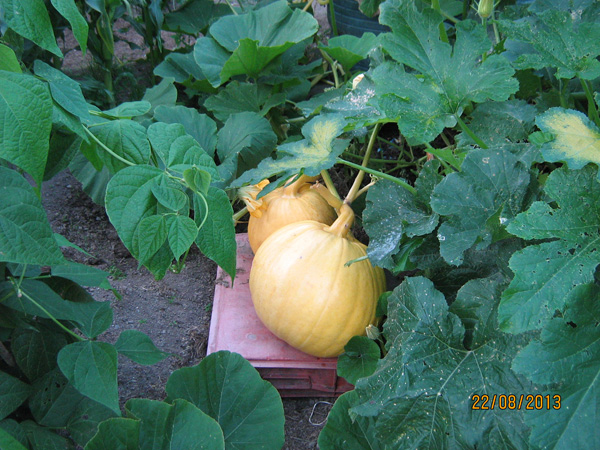
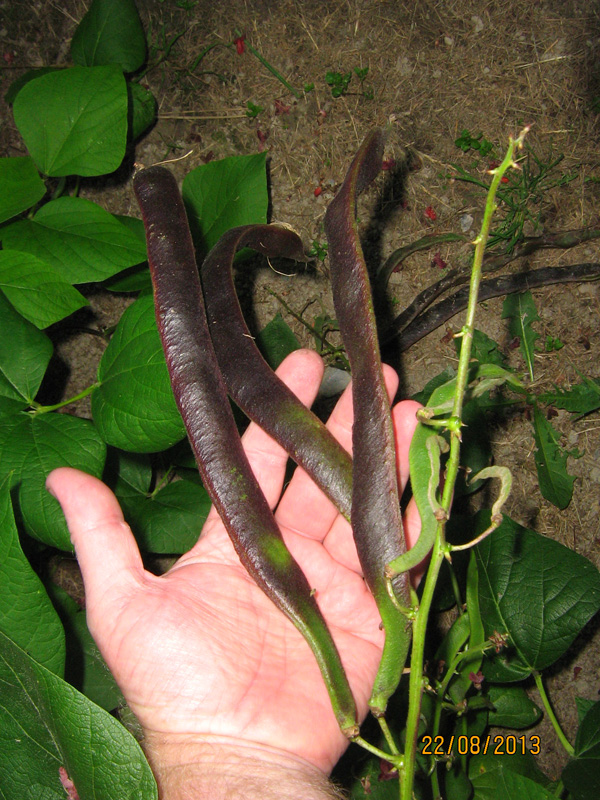
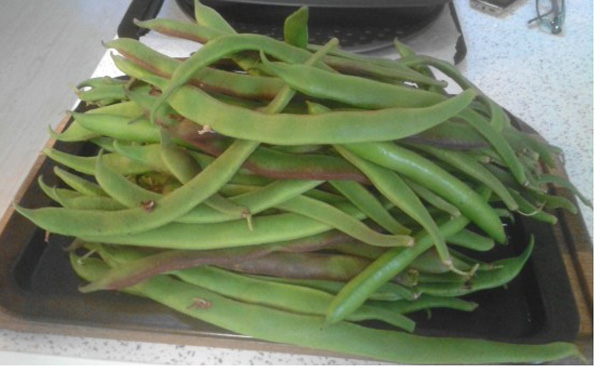
 As
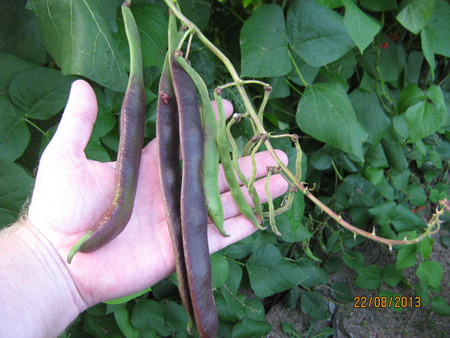
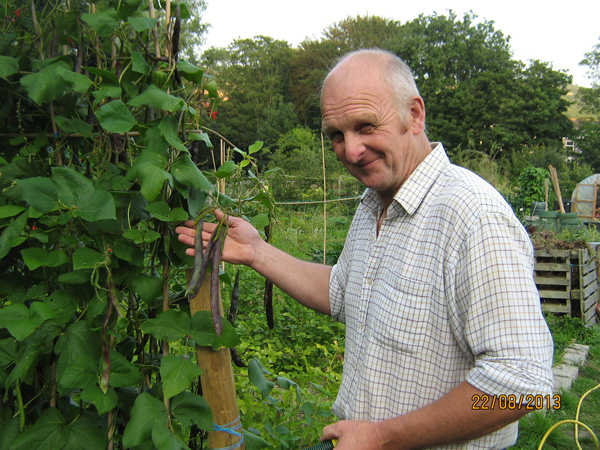
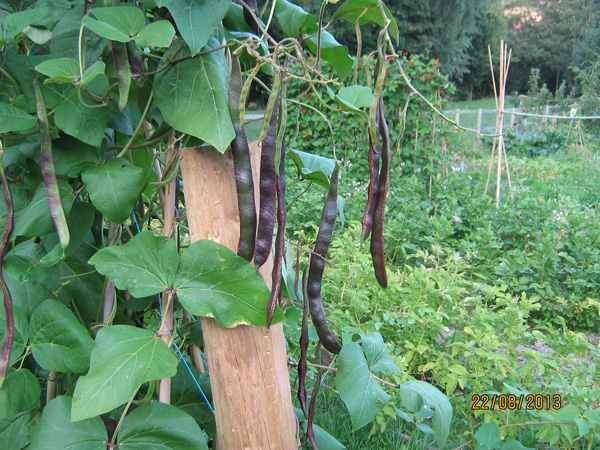
some of our more avid news-letter readers will recall, last year
I reported the discovery of a purple podded runner bean plant
that appeared in the middle of my Polestar runner beans. On maturity
the beans inside the pods were found to be jet black and shiny.
As
some of our more avid news-letter readers will recall, last year
I reported the discovery of a purple podded runner bean plant
that appeared in the middle of my Polestar runner beans. On maturity
the beans inside the pods were found to be jet black and shiny.
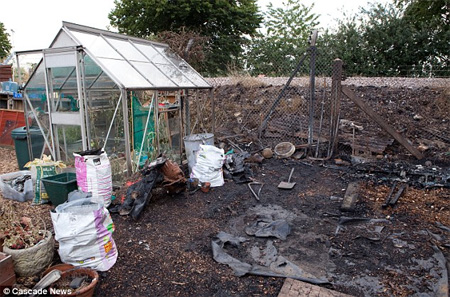 Green-fingered
allotment owners whose patches were torched after they won a
gardening competition say they were targeted by jealous
arsonists.
Green-fingered
allotment owners whose patches were torched after they won a
gardening competition say they were targeted by jealous
arsonists.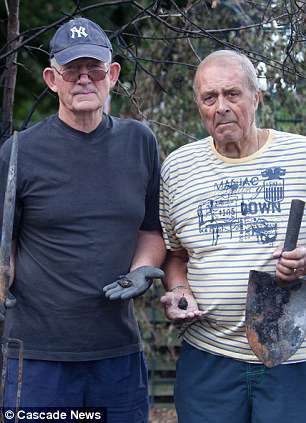 Retired
bus driver Roy Brookman, 78, said: 'Both our sheds were totally
burnt to the ground - it's so depressing.
Retired
bus driver Roy Brookman, 78, said: 'Both our sheds were totally
burnt to the ground - it's so depressing.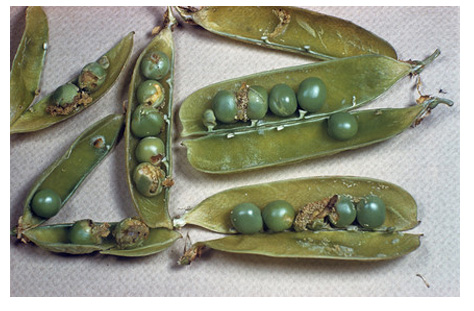
 The
pea moth, is 6mm long with a 12mm wingspan. It is an
olive brown colour with black and white bars on the
front edge of its forewings and long antennae.
Between 5 and 11 days after adult moths emerge they
lay flat transparent/white eggs (size of a pinhead)
on the leaves, pods, flowers or stems of pea plants.
The
pea moth, is 6mm long with a 12mm wingspan. It is an
olive brown colour with black and white bars on the
front edge of its forewings and long antennae.
Between 5 and 11 days after adult moths emerge they
lay flat transparent/white eggs (size of a pinhead)
on the leaves, pods, flowers or stems of pea plants.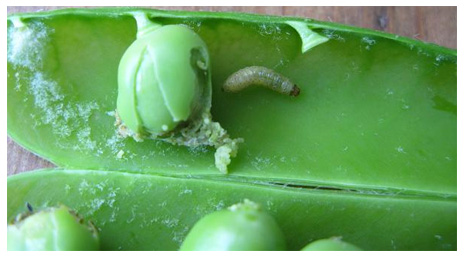 Each
caterpillar can damage up to 6 seeds although
usually damage only 1 or 2. They chew irregularly
shaped holes in the peas contaminating them with
frass (faeces). Attacked pods may yellow and ripen
prematurely, but damage is generally not detected
until the pea pods are shelled revealing the frass,
silk and sometimes the larva also. Damage is easily
distinguished from that of the pea weevil, which
makes smooth, round holes in peas.Pea moths attack
field and garden peas along with sweet peas and
vetch. Damage from pea moth is a big problem for
commercial growers but gardeners can easily discard
the damaged peas when shelling pods. Just do it
carefully! Levels of infestation can be minimised
by:
Each
caterpillar can damage up to 6 seeds although
usually damage only 1 or 2. They chew irregularly
shaped holes in the peas contaminating them with
frass (faeces). Attacked pods may yellow and ripen
prematurely, but damage is generally not detected
until the pea pods are shelled revealing the frass,
silk and sometimes the larva also. Damage is easily
distinguished from that of the pea weevil, which
makes smooth, round holes in peas.Pea moths attack
field and garden peas along with sweet peas and
vetch. Damage from pea moth is a big problem for
commercial growers but gardeners can easily discard
the damaged peas when shelling pods. Just do it
carefully! Levels of infestation can be minimised
by: 
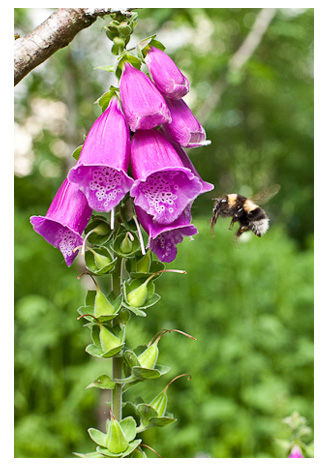 nearby. This makes them
ideal for growing in the vegetable
plot as companion plants. They also
attract lots of bees (bumble bees love
them) which will help with pollination
of other plants in the vegetable garden.
nearby. This makes them
ideal for growing in the vegetable
plot as companion plants. They also
attract lots of bees (bumble bees love
them) which will help with pollination
of other plants in the vegetable garden.
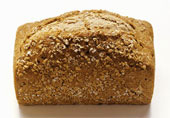 Due
to biochemical reactions in your
body that occur with every type
of food you eat on a daily
basis, some foods age you faster
than your real age, while other
foods help to fight aging.
Due
to biochemical reactions in your
body that occur with every type
of food you eat on a daily
basis, some foods age you faster
than your real age, while other
foods help to fight aging.

.jpg)