|
Egyptian Onions
(Allium proliferum)
(Also referred to sometimes as
"Walking Onions", "Tree Onions", "Egyptian Tree Onions", "Top
Onions", "Winter Onions", or "Perennial Onions" amongst other
names)
 A
genuine member of the onion (Allium) family, it is
believed that they are a hybrid cross between the common
"bulbing" onion and the Welsh onion. They have characteristics
of both. A
genuine member of the onion (Allium) family, it is
believed that they are a hybrid cross between the common
"bulbing" onion and the Welsh onion. They have characteristics
of both.
Garlic is also from this family and the
Egyptian onion also shows a remarkable resemblance to hard
necked garlic - the ones that develop scapes.
As their scientific name "Allium proliferum"
states, these hardy little onions are very "prolific." After
planting them in your garden or allotment you will have onions
every year for years to come!
Egyptian onions are very hardy, and can be
planted in the autumn.
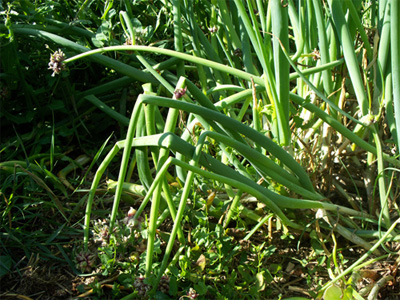 They
are called "walking" onions because of the unique way the bulbs
clusters bend down from the weight of the bulbs as they grow,
eventually touching the ground, and taking root. As the picture
on the right shows you can see them "walking" from the mother
plant by bending down under the weight of the bulbils (or
bulblets) at the top of the stalks. They
are called "walking" onions because of the unique way the bulbs
clusters bend down from the weight of the bulbs as they grow,
eventually touching the ground, and taking root. As the picture
on the right shows you can see them "walking" from the mother
plant by bending down under the weight of the bulbils (or
bulblets) at the top of the stalks.
You can divide these clusters and plant as
you would other onion sets in the autumn. They do have a rather
strong taste, so you won't need many! You can also use the green
stalks, which are edible, much like spring (bunching)
onions or chives. If you allow the new bulbs to fall over and
root, these will sprout for you to use. They are best before the
bulbs start to form on the new stalk because they do become
tough at that point. There will be enough to use for the stalks,
the bulbs and some for planting.
 In
the early spring you'll be able to dig some of the onions up to
use as bunching or green onions. In
the early spring you'll be able to dig some of the onions up to
use as bunching or green onions.
Plant the small bulbs in soil that is well
dug and amended with organic matter such as peat and compost. As
mentioned, they are very hardy so should do well even in very
cold climates.
The phenomenon of forming bulblets instead
of flowers is also seen in garlic and other various species of
Allium, which sometimes may also be referred to as top onions or
tree onions. The bulblets are generally marble-sized, usually
within 0.5 cm to 3 cm in diameter, although sizes may differ out
of this range from time to time.
Many Egyptian onions are very strong
flavoured, although some cultivars are relatively mild and
sweet. The underground bulbs are particularly tough-skinned and
pungent, and can be quite elongate, like giant scallions or
leeks, or in some types may form bulbs up to 5 cm (two inches)
across. Young plants may be used as scallions in the spring, and
the bulblets may be used in cooking similarly to regular onions,
or preserved by pickling.
|
 |
|
 |
|
Welsh
onion
(Allium fistulosum). is also sometimes referred to
as, Japanese bunching onion, it is a perennial
onion. Other names that may be applied to this plant
include green onion, spring onion, scallion,
escallion, and salad onion. These names are
ambiguous, as they may also be used to refer to any
young green onion stalk, whether grown from Welsh
onions or not - or even Egyptian onions. Many of
these references are very confusing and inaccurate.
Historically, the Welsh onion was known as the cibol.
The name "Welsh onion" has become a misnomer in
modern English, as Allium fistulosum is not
indigenous to Wales. "Welsh" preserves the original
meaning of the Old English word "welisc", or Old
German "welsche", meaning "foreign" (compare wal- in
"walnut", of the same etymological origin). The
species originated in Asia, possibly Siberia or
China. In Wales, the spring onion has a dialectal
variation, jibbons or sibwns (pronounced 'shiboons')
which originates from the French 'ciboule.' |
|
Hard-neck Garlic
(Allium
sativum var. ophioscorodon)
If you plant hard-neck
garlic, sometime in June it will shoot up a flower
stalk that is called a scape. They grow up and curl
around. It is recommended that you cut these little
guys off because if you do not, you are likely to
get smaller garlic bulbs. You can eat them – they
are highly saught after by chefs, or dry them. If
you decide to leave them on, you can harvest the
top-set bulbils to plant in the autumn. These will
produce a garlic “grass” the following summer that
is really nice in salads, or it will produce a full
sized garlic bulb in two years.
Hard-neck garlic varieties are generally hardier
than soft-neck varieties. They are the best option
for northern gardeners. They are also the best
option if you want to enjoy garlic scapes in early
summer.
Within the Hard-neck family, there are nine
sub-types of garlics: Purple Stripe, Marbled Purple
Stripe, Asiatic, Glazed Purple Stripe, Creole,
Middle Eastern, Turban, Rocambole, and Porcelain.
|
|


